
In collaboration with the Muslim Social Work Student Association and Equity, Diversity and Inclusion at the Factor Inwentash Faculty of Social Work, we’re pleased to have presented Muslim in Social Work. The exhibition invited visitors to consider the archives as a repository of strategies to approach social work more holistically. The exhibition also featured stories from Mubarka Alam, a donor at MiCA, whose materials document her work as one of the very first social workers assisting Muslim students.
 Mubarka Alam is a social worker, advocate, and mentor who has dedicated her life to women’s safety, youth wellbeing, Muslim community building, and enhancing access for under-served racialized communities in Toronto and beyond. Upon arriving in Toronto in 1966, Mubarka quickly landed a role with the Ontario government and undertook a study of night school drop-outs, attuning to the social conditions and systemic barriers students were navigating. In 1972, Mubarka completed her studies at the University of Toronto and, in the same year, co-founded the Indian Immigrant Aid Services. Filling a crucial gap, the Indian Immigrant Aid Services provided resources for newcomers from South Asia, regardless of their country of origin. Day-to-day work included settlement services such as resumé preparation, job search assistance, and referrals.
  Throughout the 70s and 80s, Alam became widely known as a case worker and expert witness for complex cases involving new immigrant communities, particularly women and people in need or in crisis. Assisting Muslim community at court, she describes her presence and participation as essential to offering clients the attention and care they otherwise weren’t receiving – particularly because there was a general lack of cultural sensitivity and, more specifically, understanding of Muslims and Islam.
  For Mubarka’s daughter, Raseema Alam, their home often had the environment of an emergency room. Mubarka would frequently take calls at all hours of the night and often leave home to assist people in crisis – offering informal services similar to, now formalized, community crisis services. Mubarka recalls that, while her role as a social worker was not always valued, the importance of this work became clear as she supported people in need.
 In 1990, Mubarka began working at the Toronto Board of Education (now Toronto District School Board) as one of the very first social workers assisting Muslim students. Following the events of September 11, 2001, Mubarka found herself travelling across Ontario to support students facing racism and anti-Muslim violence. In one occasion, when a school banned a student for making a comment about Palestine, Mubarka worked diligently to have him reinstated, rejecting the isolation and anti-Palestinian racism had had been subjected to. Mubarka’s advocacy also supported in creating religious accommodations for Muslim youth.
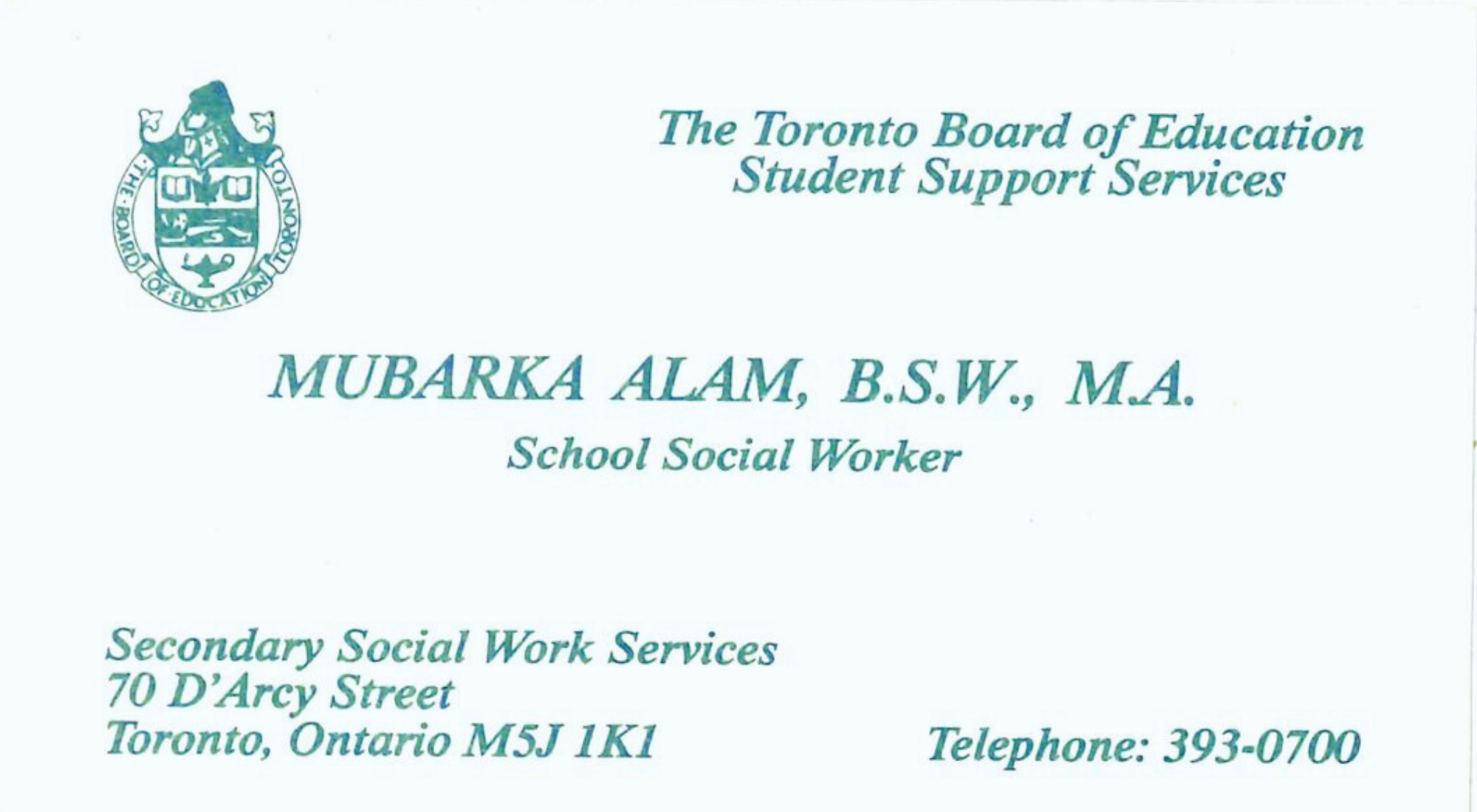 While Mubarka retired in 2006, her passion, which consistently extended beyond professional definitions of social work and towards community care, remains a testament to the value of holistic approaches to this work.
 Mubarka Alam and her family visiting the exhibition at the Factor Inwentash School Of Social Work University of Toronto.
Archival materials courtesy of Mubaraka Alam fonds and Katherine Bullock fonds.